



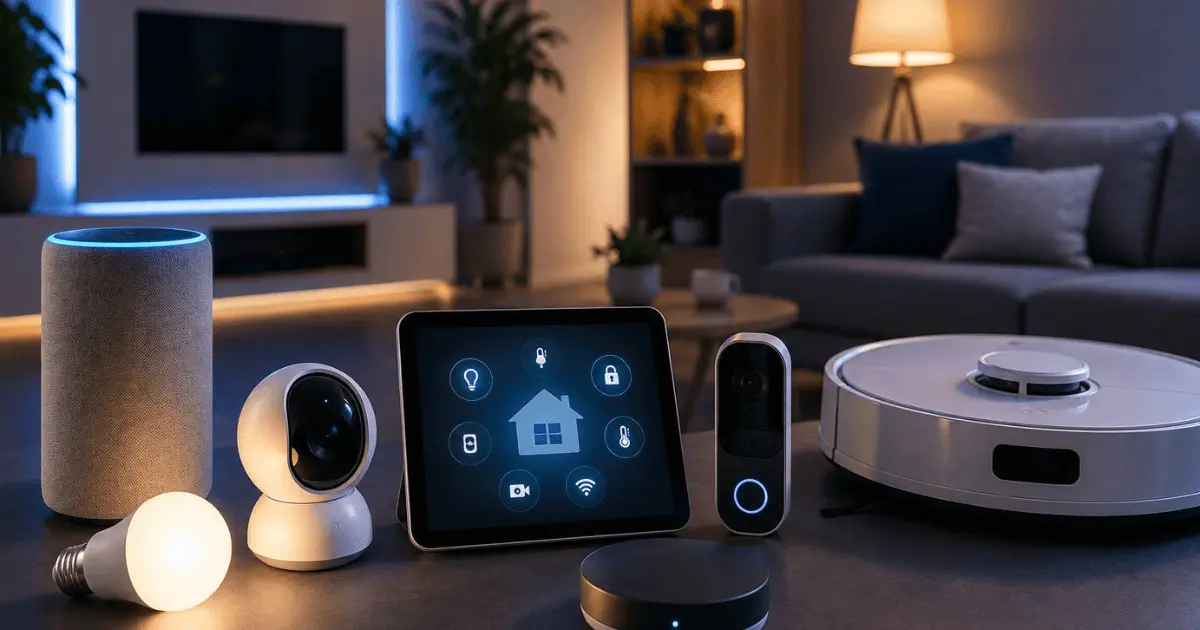
Smart home tech crossed a line in the last two years: AI assistants that actually hold a conversation, a Matter standard that lets brands finally talk to each other, and useful gadgets under $100 that used to cost three times that.
This list of the best smart home gadgets 2026 buyers should know covers 15 devices worth your money right now — voice assistants, lighting, security, cleaning robots, and a few sleepers you didn’t know you needed. Every price below was checked in August 2026.
Quick answer: Start with a smart speaker — Amazon’s Echo lineup with the new Alexa+ assistant, or Google’s Nest Audio ($119.99) with Gemini — then add a Kasa smart plug 4-pack (about $24) and Philips Hue bulbs. Biggest single upgrade: the Nest Learning Thermostat 4th gen ($279.99 with a room sensor). Updated August 2026.
Disclosure: As an Amazon Associate, TopInLists earns from qualifying purchases made through the Amazon India links in this post — at no extra cost to you. Rankings are set by our research, never by commissions. See our Advertising Disclosure.
| Rank | Gadget | Price (Aug 2026) | Best for |
|---|---|---|---|
| 1 | Amazon Echo (with Alexa+) | From under $100 (Echo Dot Max $99.99) | Voice control hub |
| 2 | Google Nest Audio (Gemini) | $119.99 | Google households |
| 3 | Echo Show 8 | Usually $180 | Kitchen command center |
| 4 | Philips Hue bulbs | ~$20 white / ~$50 color | Smart lighting |
| 5 | Kasa smart plugs | ~$24 for 4 | Cheapest first step |
| 7 | Nest Learning Thermostat (4th gen) | $279.99 with sensor | Energy savings |
| 8 | eufy C30 video doorbell | $70 | Budget door security |
1. Talk to a Smarter Home With Amazon Echo and Alexa+
The Echo lineup is still the easiest entry into voice control — music, lights, thermostat, timers, questions — and it just got its biggest upgrade in years. Alexa+, Amazon’s generative-AI assistant, is now rolling out broadly, and you don’t need a Prime membership to use it (Engadget, 2026). It handles natural back-and-forth conversation instead of rigid commands. Check price on Amazon India →
Why buy: the new Echo Dot Max ($99.99) pairs the upgraded assistant with noticeably better sound.
2. Put Gemini in Every Room With Google Nest Audio
Google’s answer is Nest Audio at $119.99, now with full Gemini for Home integration — as of March 2026 it can generate a multi-step morning routine from a single spoken prompt. A new Gemini-first Google Home Speaker (around $100) began arriving in spring 2026. Check price on Amazon India →
Why buy: if your life runs on Gmail, Google Calendar, and Android, Gemini’s answers are simply more connected than the alternatives.
3. Run the Kitchen From an Echo Show 8
A smart display earns its counter space: recipes with video, camera feeds when the doorbell rings, video calls, and touch controls for every device in the house. The Echo Show 8 — usually around $180 and frequently discounted — is the sweet spot of size, sound, and price in Amazon’s display lineup. Check price on Amazon India →
Why buy: it’s the one screen in the house that makes the rest of your smart home visible.
4. Paint With Light Using Philips Hue Bulbs
Hue remains the gold standard for smart lighting: app control, schedules, vacation-mode randomness, and voice control via Alexa, Google, and HomeKit. White bulbs run about $20; full-color bulbs about $50 each, with multi-packs cutting the per-bulb price substantially — we’ve seen white-and-color 3-packs around $69 on sale at philips-hue.com and major retailers. Check price on Amazon India →
Why buy: lighting is the smart-home upgrade you’ll notice every single evening.
5. Make Any Appliance Smart With a Kasa Plug
The humble smart plug replaced 2023’s pricier WeMo-style switches. TP-Link’s Kasa Smart Plug Mini runs about $24 for a four-pack, and the energy-monitoring version regularly dips under $10 apiece on sale. Schedule lamps, kill phantom power draw, and track exactly what that old freezer costs you. Check price on Amazon India →
Why buy: it’s the cheapest way to make dumb devices smart — and the energy readouts pay for the plug.
6. Unify Every Brand With the SmartThings Station
Samsung’s SmartThings Station ($59.99) is the budget hub of the moment: it speaks Matter, Thread, and Zigbee out of the box, ties devices from different brands into one app and one set of automations — and doubles as a wireless phone charger. Check price on Amazon India →
Why buy: Matter support means the hub you buy today keeps working with the gadgets you buy next year.
7. Cut Energy Bills With the Nest Learning Thermostat
The 4th-generation Nest Learning Thermostat ($279.99, bundled with a second-gen room temperature sensor) learns your schedule and adjusts itself. This generation adds a 60% larger display and Matter certification, and Google rates DIY installation at about 40 minutes with the Home app walking you through it. Check price on Amazon India →
Why buy: heating and cooling dominate most home energy bills — this is the gadget that works on the biggest number.
8. See Every Visitor With a $70 Video Doorbell
Video doorbells stopped being a luxury. The eufy C30 2K wireless doorbell costs about $70, records in 2K, and — like most of eufy’s lineup — stores footage locally with no mandatory monthly subscription. Package alerts and two-way talk are standard now. Check price on Amazon India →
Why buy: porch pirates and missed deliveries end the week you install one.
9. Ditch Your Keys With a Matter Smart Lock
Modern smart locks open by code, phone, fingerprint, or automatically as you arrive — and send a notification if the door’s left unlocked. The Yale Smart Lock with Matter lists at $189.99 (often discounted to around $154) and works across Alexa, Google, and Apple ecosystems thanks to Matter. Check price on Amazon India →
Why buy: temporary codes for guests and cleaners beat hiding a key under the mat in every possible way.
10. Watch Over Home With an Indoor Security Camera
The Netatmo and Canary cameras from older lists have given way to cheaper, sharper options from Ring, eufy, TP-Link, and Wyze. Look for 2K resolution, person/pet detection, night vision, and — the big 2026 differentiator — local storage so you’re not renting your own footage back as a subscription. Check price on Amazon India →
Why buy: checking on pets, kids, and deliveries from your phone is the feature everyone uses daily; security recordings are the bonus.
11. Delegate the Floors to a Robot Vacuum
The Roomba 980 era is long gone — today’s robots map your home with lasers, avoid cables and pet accidents, and empty their own bins. Consumer Reports’ 2026 testing rates the iRobot Roomba Max 705 as quiet and outstanding on pet hair (Consumer Reports, 2026); iRobot’s current lineup spans $499 to $1,399. Check price on Amazon India →
Why buy: it’s the rare gadget that literally gives you hours back every week.
12. Vacuum and Mop in One Pass With a Combo Robot
Vacuum-mop combos with self-cleaning docks are 2026’s fastest-improving category. In independent roundups this year, the Ecovacs Deebot T80S Omni keeps winning best-value honors while the budget Eufy Omni C28 covers smaller homes; Roborock and Dreame own the premium end. All are app-controlled with room-by-room scheduling. Check price on Amazon India →
Why buy: hard floors need mopping anyway — one robot doing both jobs beats owning two machines.
13. Automate Rooms Invisibly With Presence Sensors
The sleeper hit of 2026: mmWave presence sensors, around $25 each, detect that a person is in the room — even sitting still, which old motion sensors couldn’t — and trigger lights, fans, or heating automatically. No wake words, no phone, no schedules. Check price on Amazon India →
Why buy: lights that are simply on when you’re there and off when you’re not is what “smart home” was supposed to mean all along.
14. Wake Up Gently With a Sunrise Alarm Light
Philips’ wake-up lights — now under the SmartSleep name — still own this category. The light brightens gradually over the half hour before your alarm, simulating sunrise so you surface from sleep instead of being yanked out of it, with natural sounds replacing the buzzer. Check price on Amazon India →
Why buy: if dark-morning wake-ups wreck you, this fixes the worst minute of your day for less than most gadgets on this list.
15. Catch Leaks Before They Cost Thousands
The definition of a gadget you didn’t know you needed: a water leak sensor. These coaster-sized discs sit under sinks, behind the washing machine, and next to the water heater, and blast your phone the moment they get wet. Multi-packs from brands like Govee, Aqara, and YoLink cost less than a single plumber’s visit. Check price on Amazon India →
Why buy: water damage is one of the most common home insurance claims — a sensor turns a flooded floor into a mopped-up puddle.
How to Pick the Best Smart Home Gadgets 2026 Has to Offer
- Choose your assistant first. Alexa+ or Gemini — everything else should match it. Mixing ecosystems works via Matter but adds friction.
- Look for the Matter logo. Matter-certified devices work across Alexa, Google, and Apple, so today’s purchases survive tomorrow’s ecosystem switch.
- Count the subscriptions. A $70 camera with mandatory cloud fees costs more in year two than a $120 one with local storage. Total the first two years before buying.
- Start small. One speaker, a plug 4-pack, and two bulbs teach you what you’ll actually use — for well under $200 — before you commit to locks and thermostats.
More Lists You’ll Like
- Best Free AI Tools for Students
- Best Free Antivirus for Windows 11
- How to Increase Productivity in the Workplace
FAQs About Smart Home Gadgets
What smart home gadgets are worth buying in 2026?
Start with the proven four: a smart speaker (Echo with Alexa+ or Nest Audio at $119.99), smart plugs (about $24 for a Kasa 4-pack), smart bulbs, and a video doorbell (eufy C30, around $70). They deliver daily value under $250 total. Add a smart thermostat next if you pay your own heating and cooling bills.
Is Alexa+ free, and do I need Prime for it?
Alexa+ — Amazon’s generative-AI upgrade to Alexa — is rolling out broadly in 2026, and you don’t need a Prime membership to use it, per Engadget’s smart home coverage. It runs on recent Echo devices and handles conversational requests, multi-step routines, and follow-up questions far better than classic Alexa did.
What is Matter and why does it matter for buying gadgets?
Matter is the industry standard that lets smart home devices from different brands work together across Alexa, Google Home, and Apple Home. Buying Matter-certified gear — like the Nest Learning Thermostat 4th gen or Yale’s Matter smart lock — means you’re not locked into one company’s ecosystem if you switch phones or assistants later.
Are smart home devices a security risk?
They can be if neglected, but the basics close most gaps: buy from established brands that ship security updates, enable two-factor authentication on every account, keep device firmware updated, and put smart gadgets on your router’s guest network. Prefer cameras with local storage if footage privacy is a concern.
Do smart thermostats really save money?
Generally yes, because heating and cooling are most homes’ largest energy expense and a learning thermostat stops paying to condition an empty house. Savings depend on your climate, rates, and old habits — someone who already adjusted temperatures manually saves less. Many US utilities also offer rebates that cut the purchase price.
Which is better in 2026, Alexa or Google Home?
Both took big AI leaps — Alexa+ on Echo devices and Gemini for Home on Nest speakers — so the honest answer is: pick the ecosystem you already live in. Heavy Gmail/Android users get more from Gemini; Amazon shoppers and Fire TV owners get more from Alexa+. Matter support makes switching later less painful than it used to be.