



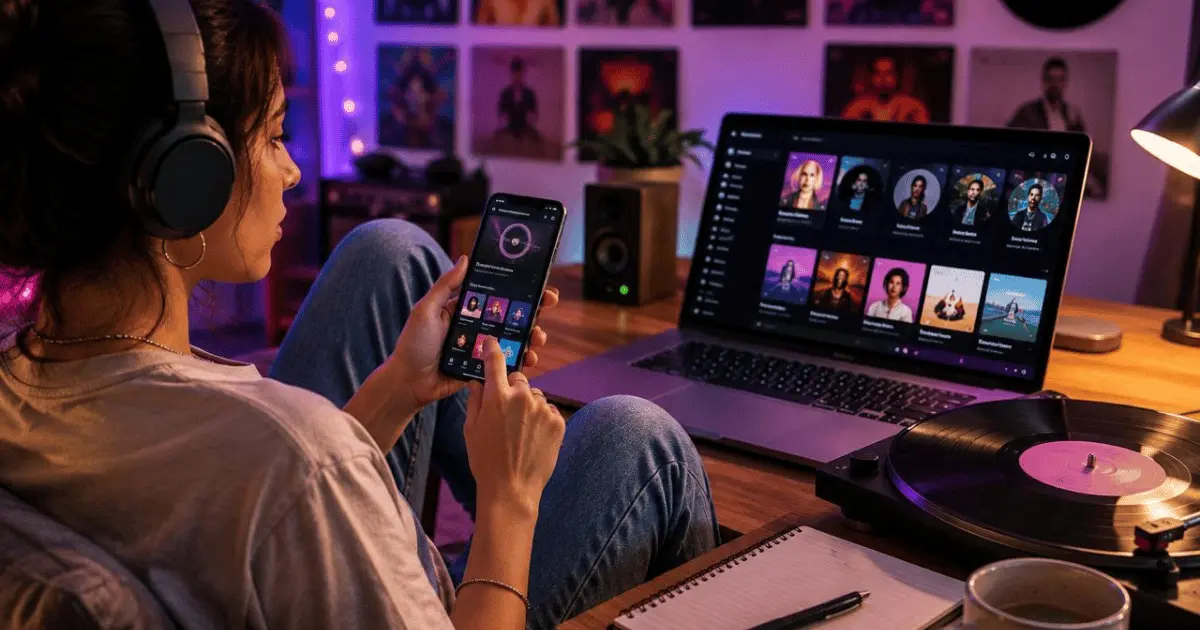
Streaming put over 100 million songs in your pocket — and somehow you’re still replaying the same 40. It’s not laziness; it’s that discovery takes a system, and most of us never built one.
Here’s how to find new music in 2026 using 12 methods that actually work: the algorithmic playlists worth trusting, the AI features worth talking to, and the human sources — friends, gigs, record stores — that algorithms still can’t replace.
Mix two or three of these into your week and your playlist will stop feeling like a rerun.
Quick answer: The fastest route is your streaming app’s discovery trio — on Spotify that’s Discover Weekly (now refreshable by genre), Release Radar, and daylist, which updates up to six times a day. Pair one algorithmic source with one human source, like a friend’s Blend playlist or a local gig, for the best of both — updated August 2026.
| # | Method | Cost | Best for |
|---|---|---|---|
| 1 | Discovery playlists | Free tier works | Effortless weekly finds |
| 2 | AI DJ + chatbot requests | Premium (DJ) | Mood-based discovery |
| 3 | Blend with friends | Free | Taste-merging fun |
| 4 | Friends’ playlists | Free | Trusted picks |
| 5 | Follow artists on social | Free | Release-day alerts |
| 6 | Short-form video + Shazam | Free | Catching viral tracks early |
| 7 | Online and niche radio | Free | Human curation |
| 8 | Bandcamp and music blogs | Free to browse | Independent artists |
| 9 | Concerts and local gigs | Ticket price | Discovering openers |
| 10 | Record stores | Free to browse | Expert recommendations |
| 11 | TV and film soundtracks | Free | Accidental gems |
| 12 | Festivals and local scenes | Varies | Bulk discovery weekends |
1. Let Discovery Playlists Do the Heavy Lifting
Every major streaming service now builds you a personal discovery feed. On Spotify, the trio to check is Discover Weekly (fresh every Monday — and as of 2026 you can refresh it by genre with a tap), Release Radar for new drops from artists you follow, and daylist, the mood-and-time playlist that now refreshes up to six times a day.
Apple Music and YouTube Music run similar personalized stations. Why try it: zero effort — the discovery happens while you make breakfast.
2. Talk to the AI DJ — Literally
Spotify’s AI DJ narrates listening sessions that blend your favorites with new picks, and since requests launched you can simply tell it what you want next — “something upbeat I haven’t heard.” Spotify also connects with ChatGPT, so you can describe a vibe in plain words and get playable recommendations back.
Any AI chatbot works as a discovery engine too: describe three songs you love and ask for ten similar but lesser-known tracks. Why try it: it’s the “related artists” rabbit hole with a guide who talks back.
3. Blend Your Taste With a Friend’s
Spotify’s Blend merges your listening history with a friend’s into one shared, auto-updating playlist. Half the fun is discovering their favorites; the other half is arguing about whose songs are carrying the playlist.
Make Blends with people whose taste differs from yours — a parent, a friend into a genre you’ve never touched. Why try it: it’s discovery with a built-in conversation starter.
4. Raid Your Friends’ Playlists
The oldest method still beats most algorithms: ask people what they’re playing. Follow friends on your streaming app, browse their public playlists, and start a collaborative playlist in your group chat where everyone adds one song a week.
When something clicks, hit the song’s “related artists” or radio feature and keep pulling the thread. Why try it: a recommendation from someone who knows you filters out 90% of the noise.
5. Follow Artists on Social Media for Release-Day Alerts
Artists announce releases, collaborations, and tours on Instagram, X, and YouTube long before playlists catch up. Following ten artists you love quietly introduces you to everyone they collaborate with, cover, or co-sign.
Turn on release notifications inside your streaming app too, so new drops from followed artists land automatically. Why try it: collaborations are the most natural bridge from artists you love to artists you’re about to.
6. Mine Short-Form Video, Then Shazam Everything
Like it or not, TikTok, Reels, and Shorts are where songs break first now — tracks regularly chart months after a 15-second clip goes viral. When a snippet grabs you, long-press to see the sound, or let Shazam identify anything playing around you.
Save finds to a running “identified” playlist and give the full songs a proper listen later — some viral hooks belong to genuinely great albums. Why try it: you’re already scrolling; you might as well leave with new music.
7. Tune Into Online and Niche Radio
Human-curated radio survived streaming for a reason: a good host plays things no algorithm would risk. Try internet stations like NTS or your streaming app’s artist-based “radio” mode, which builds an endless station from any song you feed it.
Local stations are also the best tip-off for gigs in your city. Why try it: radio forces the unfamiliar on you — which is the entire point of discovery.
8. Browse Bandcamp and the Music Blogs Still Doing the Work
Bandcamp remains the best place to find independent artists and pay them directly — browse by genre and location tags, and stream before you buy. Music publications and blogs like Pitchfork and Rolling Stone still publish new-release reviews and best-of lists that surface acts weeks before playlists do.
Newsletters from a couple of trusted outlets beat doom-scrolling for signal. Why try it: critics listen to hundreds of albums so you can cherry-pick the five worth your week.
9. Go to Concerts — and Arrive Early for the Opener
Live music imprints in a way headphones can’t. Buy the ticket even when you only half-know the artist, and always catch the opening act — openers are hand-picked by artists you already like, which makes them pre-filtered discoveries.
Check venue calendars and gig-listing apps for shows near you. Why try it: nobody forgets the band they discovered standing ten feet from the stage.
10. Visit a Record Store and Ask a Human
Record store staff are professional recommenders. Tell them three artists you love and let them hand you something — vinyl, CD, or just a name to stream on the way home. Crate-digging also surfaces album art, liner notes, and local releases no feed will show you.
Why try it: a store clerk’s left-field pick has a hit rate algorithms would envy, because they can ask follow-up questions.
11. Steal From TV and Film Soundtracks
Music supervisors are paid to find the perfect obscure song for a scene — let them work for you. When a track stops you mid-episode, Shazam it or search the show’s official soundtrack playlist; most series and films have one on every streaming service now.
Why try it: a song that scored an emotional scene arrives pre-loaded with a memory — those become favorites fast.
12. Hit Festivals and Support Your Local Scene
A festival is bulk discovery: dozens of acts across genres in one weekend. Study the lineup beforehand, star the unknowns on early slots, and wander — the small-stage 3 PM set you stumble into is the classic origin story of a favorite band.
Between festivals, follow your city’s venues and college fests, and talk to people about what they’re hearing. Why try it: local scenes are where you find artists before ticket prices find them.
How to Find New Music Without Letting the Algorithm Decide Everything
Algorithms are brilliant at “more like what you already play” — and that’s exactly their weakness. Left alone, they narrow your taste into a comfortable loop. The fix is a simple weekly ratio: for every algorithmic source (Discover Weekly, daylist, radio mode), add one human source — a friend’s pick, a blog review, a record store visit, an opening act.
One more habit that compounds: when you find a song you love, play the full album once. Albums carry context singles can’t, and deep cuts are where the algorithm rarely goes.
More Lists You’ll Like
- The best Netflix original series of 2026 — soundtrack gold mines included
- The top 15 hilarious stand-up comedy specials — for the nights music takes a back seat
- The 10 most followed Indians on X — where several of India’s biggest artists announce first
FAQs About Finding New Music
What is the best app to discover new music in 2026?
For most listeners, the streaming app you already use is the best discovery tool — Spotify’s Discover Weekly, daylist, and AI DJ, or the equivalent personalized stations on Apple Music and YouTube Music. Add Shazam for identifying songs in the wild and Bandcamp for independent artists, and you’ve covered nearly every discovery route for free.
How does Spotify’s Discover Weekly work?
Discover Weekly analyzes your listening history and compares it with listeners who share your taste, then delivers 30 songs you haven’t played every Monday. In 2026, Spotify added genre refreshes — tap a genre like pop or R&B and the playlist instantly adapts. The more you save and skip, the sharper next week’s batch gets.
How can I find new music without using streaming algorithms?
Lean on human curation: friends’ playlists, record store staff, internet radio hosts, music blogs, and live shows — especially opening acts, which are hand-picked by artists you already like. Soundtracks are another algorithm-free source. A good weekly habit is pairing one human recommendation with every algorithmic playlist you play.
How do I get out of a music rut?
Force one unfamiliar input per week: a Blend with a friend whose taste differs, a genre refresh on Discover Weekly, an internet radio hour, or a full album from an artist you’ve never played. Ruts come from repeat-listening loops — breaking one requires deliberately choosing something the algorithm wouldn’t have served you.
Is TikTok actually a good way to find new music?
Yes — short-form video is now one of the fastest ways songs break, and many tracks chart after going viral as clips. The catch is you only hear 15 seconds, so tap the sound to find the full track and give the whole song or album a real listen before judging the artist by a hook.
How do I support the new artists I discover?
Follow them on your streaming app so releases reach you, add their songs to playlists, and share tracks with friends — all of which help their algorithmic reach. For direct support, buy music or merch on Bandcamp and show up to their gigs. Small artists earn far more from one ticket or album purchase than from thousands of streams.
Streaming features described here (Discover Weekly genre refresh, daylist frequency, AI DJ requests) are per Spotify’s newsroom and can change.