



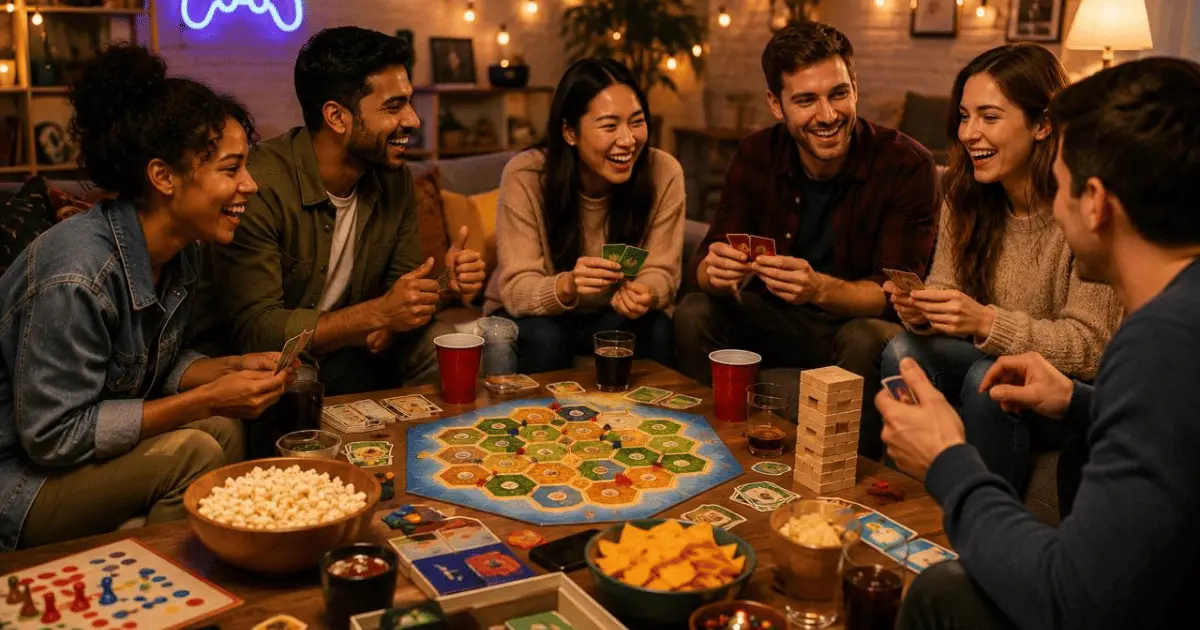
A great game night needs exactly three things: the right games, fed guests, and a host who planned ten minutes ahead. Get those right and a Friday in your living room beats most nights out — at a fraction of the cost.
This guide covers how to host a game night party from invite to last round: picking games that fit your crowd, setting the scene, feeding people without pausing play, and keeping the energy up when a game flops.
Whether it’s six friends around a coffee table or a full house tournament, these ten steps work for any group size and any budget.
Quick answer: Plan a 3-game lineup — a quick warm-up like Uno or charades, one main event like Codenames or a Jackbox Party Pack round (everyone plays on their phone), and a relaxed closer. Add one-hand snacks, a shared playlist, and a WhatsApp or Partiful invite sent a week ahead — updated August 2026.
| Step | What to do | When | Why it matters |
|---|---|---|---|
| 1 | Pick games for your crowd | 1 week before | Wrong games kill the night |
| 2 | Send invites people see | 1 week before | No guests, no game night |
| 3 | Plan a 3-game lineup | 2–3 days before | Keeps energy flowing |
| 4 | Stock one-hand snacks | 1 day before | Nobody pauses for cutlery |
| 5 | Set the scene | Day of | Comfort = longer, better night |
| 6 | Run a phone-based round | During | Includes non-gamers instantly |
| 7 | Try a tournament bracket | During | Competitive crowds love stakes |
| 8 | Theme it (murder mystery) | Occasional | Turns game night into an event |
| 9 | Keep backups ready | Always | Rescues a flopping game |
| 10 | Capture and share the night | After | Guarantees a sequel |
1. Pick Games That Match Your Crowd, Not Your Shelf
The best game is the one your specific guests will actually enjoy. Mixed group with non-gamers? Go for easy-to-teach party games — Codenames, Uno, charades, Pictionary. Competitive friends? Strategy games and trivia. Families? Ludo, carrom, or a co-op game where nobody’s kid brother loses badly.
Two rules of thumb: every game should be teachable in under five minutes, and rounds should be short enough that losing isn’t a life sentence. Why it works: people forgive average snacks; they don’t forgive a 45-minute rules explanation.
2. Send Invitations People Actually See
Skip the buried group text. Create a dedicated WhatsApp group, a Partiful or Google Calendar invite, and send it about a week out — long enough to plan, short enough that no one forgets. Include date, time, address, and what to bring (a snack, a favorite game, drinks).
Mention the headline games in the invite. “We’re settling the Codenames rivalry” gets more yeses than “game night, I guess.” A day-before reminder in the group quietly doubles turnout. Why it works: excitement starts at the invite, not the doorbell.
3. Plan a Three-Game Lineup With an Energy Curve
Structure the night like a playlist: a warm-up game while stragglers arrive (Uno, a quick quiz), the main event once everyone’s in (Codenames, a Jackbox round, team trivia), and a wind-down game for the final hour when brains are tired.
Keep each game to 20–40 minutes so everyone gets multiple rounds and no single loss defines the night. Why it works: pacing is the invisible difference between “fun night” and “we played one long game and Riya fell asleep.”
4. Stock Snacks You Can Eat With One Hand
Game night food has one job: keep hands free and cards grease-free. Think popcorn, pretzels, cut fruit, nuts, samosas or sliders in bite sizes — anything that doesn’t need a plate, a fork, or a pause in play.
For drinks, set up a self-serve station with soda, water, and a pitcher of something special — a themed mocktail costs almost nothing and feels like an occasion. If you’re serving alcohol, keep non-alcoholic options equally good, not an afterthought. Why it works: a fed guest is a patient guest, even three rounds into a losing streak.
5. Set a Scene That Says “Stay Awhile”
Pick the room with the biggest table and add more seating than you think you need — chairs, cushions, bean bags. Good overhead light matters more than mood lighting when people are reading cards; save the dim-and-cozy setup for the wind-down hour.
Put on a shared playlist at conversation volume — better yet, start a collaborative Spotify playlist in the invite group so guests add songs before they arrive. Why it works: comfort decides whether people leave at 10 or stay till 1.
6. Run a Phone-Based Round So Nobody Sits Out
The easiest 2026 upgrade to game night: games where every phone becomes a controller. A Jackbox Party Pack on any TV with a laptop or streaming stick gets the whole room drawing, bluffing, and voting within minutes — no rules to learn, no pieces to lose.
Free alternatives work too: online trivia platforms and browser party games like skribbl.io need nothing but a shared screen. Why it works: the friend who “doesn’t do board games” will happily roast everyone in a drawing game on their own phone.
7. Add Stakes With a Tournament Bracket
For competitive groups, turn the night into a championship. Draw names from a bowl to form random teams, run short elimination rounds, and crown a winner with a ridiculous trophy — a ₹100 tiara, a rubber chicken, custom certificates. The sillier the prize, the harder people fight for it.
Random teams are the secret ingredient: they break up couples and cliques, and give newcomers instant teammates. Why it works: stakes plus silliness is the exact formula for stories people retell for months.
8. Level Up Occasionally With a Murder Mystery Theme
Once you’ve hosted a few standard nights, try a themed edition. Murder mystery kits — plenty are available online as printable or emailed packs — assign each guest a character in advance, and the whole evening becomes a whodunnit played over snacks.
Send character cards with the invite so guests can dress the part, and encourage photos all night for the group chat the next morning. Why it works: a theme turns “game night at Sam’s” into an event people mark on their calendar.
9. Keep Two Backup Games Within Reach
Every host eventually watches a game die on the table — rules too fiddly, one player steamrolling, energy gone. Don’t rescue it; replace it. Keep two crowd-pleasers ready (a deck of cards and one guaranteed-laugh party game) and make the swap without ceremony.
Also set up a comfortable spectator corner. Some guests genuinely enjoy watching with a drink, and that’s a valid way to attend. Why it works: flexibility is the host skill that separates good nights from great ones.
10. Capture the Night and Book the Sequel
Start a shared photo album (Google Photos does this in two taps) and drop the link in the group chat. The morning-after flood of terrible action shots and victory poses is half the fun — and the best advertising for round two.
Before everyone leaves, float the next date while enthusiasm is high. A monthly rotation where hosting duties pass around the group keeps it sustainable. Why it works: game night isn’t an event, it’s a tradition — and traditions get scheduled.
How to Host a Game Night Party on a Budget
You don’t need a shelf of new board games. A single deck of cards covers a dozen games; charades and Pictionary cost nothing; skribbl.io and other browser games are free; and asking each guest to bring one game plus one snack spreads the cost to nearly zero.
If you buy one game, make it a versatile party staple like Codenames or Uno — high replay value, works from 4 to 8+ players, and survives spilled soda. Check prices across Amazon and local stores before buying; party game prices swing widely between sales.
More Lists You’ll Like
- Binge-worthy TV shows — for when the group votes to end game night on the couch
- The top 15 hilarious stand-up comedy specials — perfect wind-down viewing after the trophy ceremony
- Budget-friendly date ideas for couples — a two-player game night is one of them
FAQs About Hosting a Game Night Party
How many people should I invite to a game night?
Six to ten is the sweet spot. It’s enough for teams and tournament brackets but small enough that everyone plays every round. Below four, stick to card games and two-versus-two formats. Above ten, split into two tables with different games and rotate players between rounds so groups mix.
What are the best games for a group with non-gamers?
Choose games with rules you can explain in one breath: Uno, charades, Pictionary, Codenames, or a Jackbox Party Pack round where everyone plays on their phone. Avoid long strategy games for mixed groups — the moment someone needs a rulebook consultation mid-turn, casual players mentally check out.
How long should a game night party last?
Plan for three to four hours: thirty minutes of arrival and snacks, two to three games in the middle, and a relaxed final hour. Ending while people are still having fun beats stretching until everyone’s exhausted — it’s the single best trick for making sure they come back next month.
What food should I serve at a game night?
One-hand, low-mess snacks: popcorn, pretzels, nuts, cut fruit, bite-size samosas or sliders. Keep napkins on the table and drinks on a separate station to protect cards and boards. A self-serve setup means you actually get to play instead of running a kitchen all night.
How do I host a murder mystery game night?
Buy or download a murder mystery kit sized for your guest count, then email each player their character card a few days ahead so they can plan a costume. On the night, you act as narrator while guests interrogate each other over snacks. Most kits run two to three hours.
What if a game is boring and killing the mood?
Swap it, fast and without apology. Announce a snack break, then start a different game when people sit back down. Keep two reliable backups within reach — a deck of cards and one guaranteed party hit. No game is worth protecting at the cost of the room’s energy.